Sunday, November 27, 2011

An iPhone That Changes Color With Heat!!!!

There are a lot of cool mobile device accessories you could put on your Christmas shopping list and one of them should probably be RF Laserworks’ heat sensitive backing for the iPhone. It’s self adhesive so you just slap it on to the back of your iPhone 4 or 4S and then watch your mobile change color depending on the temperature of the surface it comes in contact with. That would most frequently be either your hand or your pocket.

When the backing is black in color that means it’s still cold. Then it moves up from red, yellow, green, and finally to deep blue as the temperature rises. The material used is sensitive to within 90-95 degrees Fahrenheit. It’s also only .005 inches thick, which means it will fit nicely under any other protective wrapping you put on your Apple phone. Remember those mood rings back in the latter part of the 1970’s? Well you can basically turn your iPhone into one with this sort of backing.

‘Twine’ Foreshadows A Future Where All Objects Talk To The Internet


Now Operate your household through internet..........

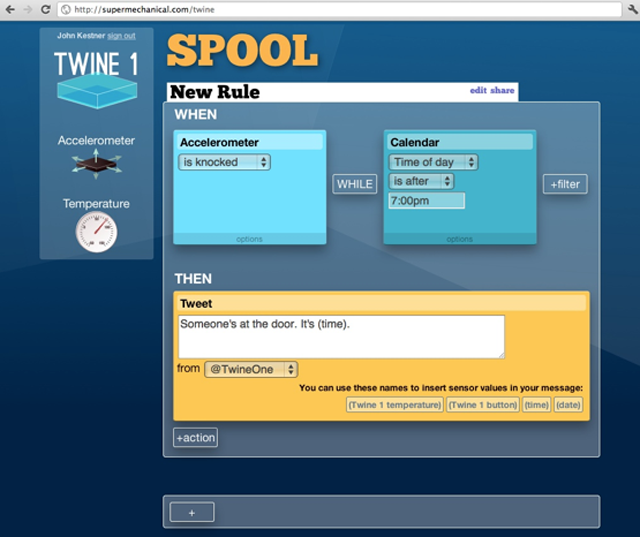
Screen Shot 2011-11-25 at 4.58.05 PM
Want to be notified to turn on the AC when a room reaches a certain temperature? Or when your laundry’s done? Well MIT Media Lab alumni Supermechanical have built Twine, a sleek 2.5″ rubber square which connects to Wifi and allows objects to “communicate” under certain conditions.
The Twine, which reminds me of a Square from a design simplicity perspective, comes with a web app, ‘Spool’ which allows you to program its sensors with natural language rules like “When: accelerometer is at rest, Then: Tweet” in the case of the laundry done thing, for example.
You can hook up the battery operated Twine to communicate through SMS, Twitter, Email and even HTTP requests if you’re into that sort of thing.
The basic Twine comes with an internal temperature sensor and an internal accelerometer, and the Twine guys are making optional external sensors including a magnetic switch for doors, a moisture sensor and a breakout board for those of you that want to create your own DIY sensor action. Supermechanical says that it will develop additional sensors for every $10K over its Kickstarter funding goal. Possible options include an RFID reader, a pressure sensor and/or current sensor.

After a stint on Hacker News, the project has received over $60K in funding, and with a donation of $90 you can order your own Twine through Kickstarter — A perfect gift for the person who has everything but a refrigerator door with its own Twitter account.


Samsung Galaxy Ace Review!!!

Samsung announced their latest budget Android smartphone, the Samsung Galaxy Ace back in January, and we have just been testing the Galaxy Ace for the last week.
The Samsung Galaxy Ace comes with Android 2.2 Froyo, and it has just recently gone on sale in the UK, it comes with a range of features you would expect too see in a more expensive smartphone.
Samsung Galaxy Ace

Specifications

As I mentioned previously, the Samsung Galaxy Ace comes with Android 2.2 Froyo out of the box, hardware wise you get 3.5 inch capacitive touchscreen display with a resolution of 320 x 480 pixels.
Samsung Galaxy Ace
Processing is provided by an 800MHz processor, and there is also a five megapixel camera with 2x digital zoom and an LED flash, plus a range of shooting modes and photo effects.
You also get a built in FM Radio, Bluetooth 2.1, integrated 802.11 b/g/n WiFi, plus a microSD card slot, the model we tested came with a 2GB microSD card but it can take up to 32GB microSD cards.
The Samsung Galaxy Ace features 1350mAh battery, and the manufacturers specifications say that you will get up to 660 minutes of talk time on 2G, 390 minutes on 3G, plus up to 640 hours of standby time on 2G and 420 hours on 3G.

Design, Display and UI

The Samsung Galaxy Ace is designed to be a budget Android device, although it does feel very well made, maybe not as high as the Samsung Galaxy S, but it certainly feels better quality than the Samsung Galaxy Europa we tested recently.
Samsung Galaxy Ace
The display is sharp and crisp and the design is excellent and it certainly feels very well made, and could quite easily be mistaken for a more expensive smartphone.
It comes with a pair of interchangeable covers, one black and one white, the black one features a rubberized texture which makes the phone easy to hold, whilst the white cover is smooth, and feels a bit more like plastic than the black one.

Camera

The camera on the Samsung Galaxy Ace is a five megapixel version, it also features two times digital zoom, and it is capable or recording video in a 320 x 240 resolution, no HD here unfortunately, and this is one of the cameras week points, the video recording isn’t the best, but I suppose this can be forgiven for the price.
Samsung Galaxy Ace
The camera on the Galaxy Ace is pretty good ,  it does a good job at capturing pretty decent photos and it has a range of features built in which include autofocus, a range of shooting modes which include continuous and panorama plus a range of photo effects.

Conclusion

The Samsung Galaxy Ace is designed to be a budget Android smartphone, and I must admit I was pleasantly surprised with it, as it has a range of features that you would expect in a more expensive Android device.
Samsung Galaxy Ace
It definitely feels a lot better quality that some of the other budget Android devices we have tested, and feels very well built, the display is sharp and crisp and the touchscreen is responsive.
The camera is decent, it will do a good jobs on photos, video is another matter and if you are the sort of person who uses your smartphone for recording a lot of videos you may want to consider something else.
Overall we really liked the Samsung Galaxy Ace, for the money it is an excellent budget smartphone, very well made and very well designed, if you are in the market for a budget Android device, I would definitely recommend you add the Samsung Galaxy Ace to your list of devices to check out.
The Samsung Galaxy Ace is available in the UK from a range of mobile operators, the model we tested was from mobile network Three, who are currently offering the Galaxy Ace for £199.99 on pay as you go and also with a range of their monthly contracts.
Make sure you check out our Samsung Galaxy Ace gallery below for lots more photos of this budget Android smartphone.

FireText Alerts You When Your House Is Burning Down

In the unfortunate circumstance of a fire or some unprecedented disaster in the kitchen, the FireText alerts several users via SMS. Distressing, but at least it affords the recipient time to mitigate the disaster. It’s better than coming home to a house in ashes. Anyway, the FireText is a rugged smoke alarm powered by a lithium battery. It can manage 36 activations (or 36 separate fire sin your house) and has a maximum lifespan of five years. That is, if it doesn’t go down with the house during an infernal blaze.
FireText
Upon activation, the user installs an SMS message that’s transmitted to them when the dreadful emergency happens. Even better, the FireText can be set to deliver a total of four messages during an emergency.
The FireText also works as a smoke alarm and manages a noisy screech to alert everyone that the end is nigh.
Released earlier this year, the FireText is currently selling for 90 quid.

Saturday, November 19, 2011

Today in History


November 19th, 1998 - Half-Life Sets FPS Gaming on Fire

Postby Chandrayog, Sat Nov 19, 2011 8:52 am
Sierra Entertainment (remember them?) knew marketing REALLY well and they displayed this knowledge rather succinctly in the way they doled out information for their, then, upcoming First Person Shooter (FPS) title, Half-Life on PC. Information was kept under lock and key, carefully given out to the press at certain times so as to control who knew what and when and to ensure no one knew the whole story. Couple this marketing strategy with the fact that Half-Life was released during a highly competitive, and lucrative, time for 3D card manufacturers and you have a mix for success (remember the days when games supported ONE chipset an if you didn't have that one you were relegated to "software" rendering?).

Image

Half-Life was a unique game from this new company called Valve Corporation (they eventually did go on and make something called Steam for PC). By this time in history, there were a ton of titles using the Quake engine doing their best to emulate id's tour de force but Valve was different. Valve went another direction, they added a story to the mayhem, added many scripted events (think cutscenes but using the game engine so they are not so jarring to the immersion factor). On top of all of that, Half-Life was actually interesting to play, scary sometimes and was quite effective at making gamers believe they were in a top secret government facility that has gone terrible off course (no spoilers folks).

I remember following Half-Life in various gaming magazines such as PC Gamer, PC Games and Computer Gaming World and I fondly remember the day that I purchased the issue of PC Games that had a huge spread on Half-Life. Then came the first demo, over 100 megs (doesn't sound like much now but back on 56k that was a lifetime of downloading). I was blown away, even though on my computer it stuttered really bad I still trudged through the demo enjoying every second of it.

Half-Life was going to be available on Dreamcast but was cancelled at the last second but has successfully hit the PS2 in a weird "co-op" version. In recent years, Half-Life 2 has gone episodic, not sure if that is a viable distribution choice when releases are YEARS apart but Valve is trying it out to whatever fanfare they are receiving for it.

Wednesday, November 16, 2011

Green Tech!

A cistern is a tank or barrel used for storing rainwater that is collected from a roof or other catchment area. Cisterns are used as a supplement to other water sources; they are very useful when the source of water for a home is limited during dry periods of the year. In many areas, supplies of groundwater are limited. To conserve groundwater, rainwater can be used for such things as watering gardens or washing cars. However, chlorine must be added if the water is intended for domestic use. As world fresh water resources decline, water obtained by alternative methods will be in greater and greater demand. There is no better place to find water than from the natural runoff and in one’s own backyard.  
   
 
Typical 1500 gallon cistern with two
downspouts


Typical rainbarrel  


Green Tech!!!!!!!

Composting toilets (also called “dry sanitation systems”) have been in existence for over thirty years and during this time, have been used broadly in rural settings and other locales where centralized wastewater treatment is not feasible.    Composting toilet systems differ fundamentally from conventional toilet systems in that they do not make use of potable water to transport human waste off-site for treatment, but rather contain waste on-site where pathogens are killed and nutrients are recycled in localized biological cycles. 
(Figure 1: Typical Composting Toilet)
Though early application of composting toilets in the U.S. was largely limited to rustic and outdoor settings, this simple technology is now gaining increased attention for its potential use in urban settings due to a number of appealing environmental advantages over conventional systems:
  • No potable water is required for the system to function properly – this results in significant water conservation benefits (up to 30% savings.)   A conventional toilet uses up to 5 gallons of potable water per ounce of human waste. 
  • Because no black water (sewage water) is created, the need to treat sewage water before releasing it into receiving waters is eliminated. Furthermore, because other household grey water sources (laundry, kitchen, shower) are not mixed with human waste, these sources become more viable for reuse on-site.
  • Composting toilets, when designed and maintained properly, control pathogens at their source.   This reduces the potential for soil and groundwater contamination from deteriorating conventional piping infrastructure.  
  • The energy (and CO2 equivalent) required to build and maintain
    distributed composting toilet systems is significantly lower than that
    required for centralized waste water treatment facilities and associated piping and pumping infrastructure
  • Disruption to ecological systems (soil structure, tree root systems, etc.) during pipeline installation (or repair) is eliminated.
  • Because composting toilet systems do not produce black water, they do not contribute to combined-sewer overflow events which is particularly beneficial in areas where this is an environmental and regulatory concern.


  • Composting toilets provide the infrastructure to recycle other organic household waste, such as food scraps, paper and lawn clippings, on site. 
  • Composting toilet systems produce a useful and valuable product (compost) that can be reinvested on-site to build soil structure and soil fertility.   In conventional systems, this potential resource is landfilled.
These advantages notwithstanding, concerns about the safety of composting toilets (from a public health perspective) still present a considerable obstacle to their broad application in urban settings.   The laws governing composting toilets in Washington State are summarized and referenced in the “Application” section of this article.